
Sources for Eau Claire Neighbors
Looking up Eau Claire neighbors is a block-scale task. The county GIS supplies parcel shapes, Beacon and Ascent connect those parcels to assessed owners, voter data adds limited civic records, and city-recognized neighborhood groups provide public contacts. Historical directories can show who was listed on the block in an earlier year. None is a complete current household roll, so the source and its date must stay attached to each fact.
| Source | What It Shows About a Block | Access |
|---|---|---|
| County tax-parcel GIS | Parcel polygons, IDs and spatial context | Free ArcGIS service |
| Beacon and Ascent | Assessed owner, situs, mailing address and tax year | Free public portals |
| Badger Voters | Eligible nonconfidential voter names and addresses | Filtered request and quoted fee |
| City neighborhood directory | Association areas and public civic contacts | Public directory; no full roster |
| Historical directories | Past address listings on a block | Library, archives and digital volumes |
A tax roll proves who the assessor lists as owner, not who sleeps at an address. A separate mailing address may belong to an owner who lives elsewhere. The voter list leaves out children, people who do not register, confidential electors, and many other occupants. Use the records to understand land ownership and public civic context, not to declare an exhaustive list of your neighbors.
Click Parcels Beside Eau Claire
The Eau Claire County tax-parcel GIS service is the spatial starting point. Find the subject polygon, zoom to the street segment, and inspect each polygon that touches it. A parcel across an alley or road may be close but not legally adjoining. Record its parcel ID before opening the tax record, since street spelling and unit formats can vary.
The service supports identify, query, selection, and export operations. Available context can include parcel boundaries, 911 address points and centerlines, zoning, floodplain, aerial imagery, and political districts. No exact radius or buffer tool was confirmed, so do not claim one. GIS is advisory and may contain compilation errors. A recorded plat, certified survey map, survey, or deed controls a legal-boundary question.
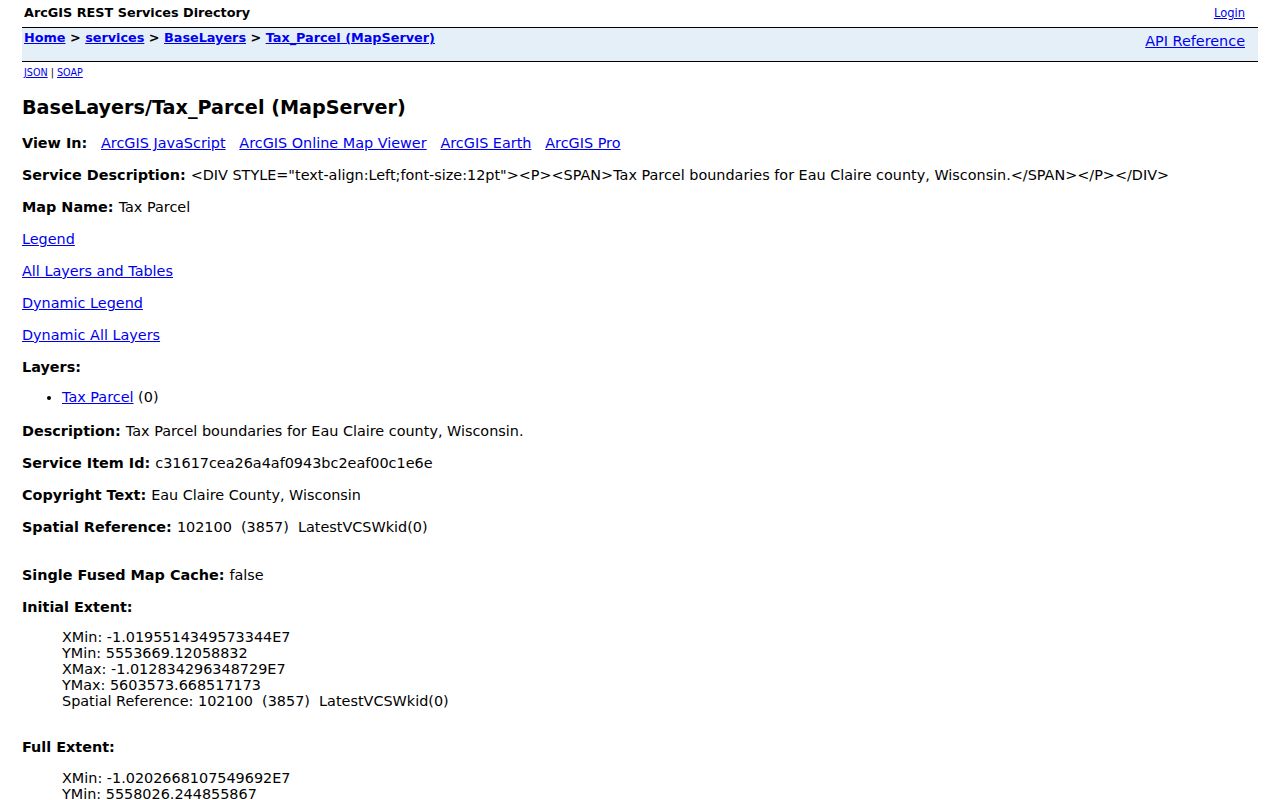
The captured county service identifies the authoritative layer and query tools, making it possible to preserve a parcel reference before comparing neighboring tax records.
Map an Eau Claire Block
Move outward from one verified address, one parcel at a time. This keeps the neighbor search tied to a visible block instead of turning a street name into an overbroad list. Maintain a small worksheet with parcel ID, situs address, assessed owner, owner mailing address, legal description, tax year, and source date.
- Locate the address in City Beacon or county GIS. Note the subject parcel polygon and parcel ID.
- Click each immediately adjoining polygon. Include parcels across a road only when proximity, not legal adjacency, is the question.
- Open each parcel in County Ascent or Beacon. Copy the situs, owner, mailing address, legal description, and tax year exactly.
- Check a recorded plat or deed before making a boundary claim. Streets, rivers, rail lines, rights-of-way, and public parcels can interrupt apparent adjacency.
When the question expands beyond the immediate block, the Eau Claire street directory explains the full named-street record chain. Keep this block method focused on the small ring of parcels around the starting point.
Confirm Eau Claire Parcel Owners
Use City Beacon for city assessment cards and mapping, then use County Ascent for the broader land and tax record. Ascent accepts owner name, mailing address, street, municipality, and parcel ID without a public login. The parcel ID is the cleanest bridge from the map to a record.
| Worksheet field | What it means |
|---|---|
| Parcel ID | The county identifier for that tract |
| Situs address | The physical location assigned to the parcel |
| Owner and mailing address | The assessed owner and destination for notices |
| Legal description | The lot, block, subdivision, or survey description |
| Tax year and source date | The time stamp needed to judge currentness |
Do not convert a matching mailing address or tax credit flag into a claim that the owner occupies the home. A trust, estate, company, or absent owner can appear on the roll. The public parcel card contains no household roster.
Eau Claire Voters by Block
MyVote Wisconsin checks a specific voter's registration with first name, last name, and birth date, or finds election information from an address. It does not browse all voters on a block. For a lawful filtered file, Badger Voters lets a requester select Eau Claire County, municipality, ward, and related districts, see an estimated count and cost, pay, and download a CSV.
Wis. Stat. §6.36 allows public voter information such as name, residential address, municipality, ward, status, districts, and elections in which the voter participated. It withholds birth dates, driver's-license numbers, Social Security numbers, confidential-elector data, and voting accommodations. Ballot choices are never public, and Wisconsin does not register voters by political party. Even a lawful file remains a list of eligible nonconfidential electors, not every household member.
Note: A voter file can add civic context to Eau Claire neighbors, but it cannot prove a complete household or reveal anyone's ballot.
Eau Claire Neighborhood Contacts
The City of Eau Claire neighborhood program recognizes associations that maintain active bylaws, a board, and a budget. Its map and directory are useful for boundaries and public civic contacts. The inspected sources do not show complete member rosters. A neighborhood boundary marks a civic service area, not a verified list of residents.
Central neighborhoods
East Side Hill, Historic Randall Park, North River Fronts, and Third Ward appear in city district and planning material.
North and south
Airport, Dells, North Side Hill, Princeton Valley, Sundet, South, and Putnam Heights are named city association areas.
West neighborhoods
Buffington, Shawtown, Upper Westside, and Westridge appear in the city's west-district discussion.
Public civic contacts
Third Ward and Downtown groups publish meetings, events, or contact routes, but no public resident roster was found.
City event rules reinforce the distinction. An association board member applies in advance, events stay within association boundaries, and promotional material must say the event is for residents inside that area. Those rules support civic administration, not a public directory of Eau Claire neighbors.
Boundaries Around Eau Claire Neighbors
The city plans collection covers East Side Hill, Historic Randall Park, North River Fronts, North Side Hill, Shawtown, Third Ward, West Riverside, and other areas. Planning lines can explain shared projects, land use, and civic identity. They do not match parcel lines, ZIP delivery areas, wards, school districts, or association membership in every place.
Eau Claire County and the city jointly maintain the NG911 centerline and address-point geodatabase, while USPS ZIP codes follow mail delivery. That geography can produce different answers for the same corner. Use the parcel polygon for ownership, the ward for election administration, the ZIP for delivery, and the plan boundary for civic context. Never blend them into one household claim.
Compare Eau Claire Neighbor Sources
Official rolls and commercial neighbor tools answer different questions. Government systems are tied to a custodian and a public purpose, while commercial products compile material from many dates and may merge similar people. A polished profile does not make the underlying match official.
| Source type | Strength | Main limit |
|---|---|---|
| GIS and tax roll | Parcel identity and assessed owner from the local custodian | Owner is not necessarily an occupant |
| Voter file | Eligible nonconfidential elector and civic districts | Not a household list; protected fields withheld |
| Neighborhood group | Public meetings, plans and civic contacts | No verified public member roster |
| Commercial compilation | May combine broad directory clues | Can be stale, conflated, incomplete or costly |
For a parcel fact, verify with Beacon, Ascent, GIS, or the Register of Deeds. For a civic boundary, use the city. If a commercial listing is wrong, its opt-out process is separate from correcting the official source.
Past Eau Claire Neighbors
Historical context can explain a block without pretending to identify its present households. UW-Eau Claire Special Collections holds city directories beginning in 1880, Periscope yearbooks from 1917 through 1995, census and atlas microfilm, maps, manuscripts, and organization records. L.E. Phillips Memorial Public Library adds newspapers from the 1850s, Sanborn maps, local indexes, and cemetery or obituary routes.
A historical directory may list an address, occupation, spouse, or householder for one printed year. Sanborn maps show buildings and uses rather than a complete set of names. Cemetery, church, club, and obituary records can restore family or community context, but dates and spellings must be checked. For historical collections themselves, use the city directory page rather than treating an old entry as evidence about current Eau Claire neighbors.
Privacy for Eau Claire Neighbors
Utilities, delivery records, private contact lists, and many household facts are not public block directories. Wisconsin voter law protects birth dates, license and Social Security numbers, confidential electors, accommodations, and ballots. The Wisconsin DOJ Safe at Home program, under Wis. Stat. §165.68, gives qualifying people a substitute address and mail forwarding when physical safety is at risk.
A protected address should not be reconstructed from parcel, court, voter, or social clues. Public registry information also has a defined statutory scope and cannot substitute for court files or a current household check. If a record is wrong, contact the custodian that created it rather than spreading the error.
Lawful use. Use neighbor records for lawful civic, property, family-history, or personal-safety research. Never watch, harass, threaten, or intimidate an Eau Claire neighbor.