
Eau Claire Directory Years and Shelves
Eau Claire city directory research begins with overlapping collections, not one complete shelf. UW–Eau Claire Special Collections identifies a city directory beginning in 1880, available in its reading room. The Chippewa Valley History collection provides digital access from 1880 through 1923. Later years appear in outside repository lists, but a catalog record does not prove a copy is online or locally shelved.
| Collection | Years | Where Held | Access |
|---|---|---|---|
| Local city directories | Beginning 1880 | UWEC Special Collections | Reading room, no checkout |
| Chippewa Valley History scans | 1880–1923 | L.E. Phillips partners and Recollection Wisconsin | Digital collection |
| Later holdings | Selected years, 1926–1960 | NARA and Allen County catalogs | Verify access by year |
| Telephone directory list | Selected years, 1960–2014 | Milwaukee Public Library shelf list | Check local access |
Known editions include 1880, 1882, 1884, 1885, then many selected years through 1960. The sequence does not prove an unbroken annual run. Check each year in the UWEC, public-library, digital, or outside catalog. The exact last printed city directory and the local run of separately titled reverse volumes were not verified.
Eau Claire City Directory Publishers
The publisher matters because layout, symbols, and scope can change. Identified runs include R.L. Polk & Co. in parts of 1887–1895, Eau Claire Directory Co. around 1899–1900, and Wright’s Directory of Eau Claire from 1905 through 1923. Early books also use titles such as Eau Claire City Directory and Directory of the City of Eau Claire.
Do not merge these into one Polk run. A missing year may be a catalog gap, another publisher, or an edition not yet digitized. Read the title page and front matter before comparing entries. They establish the edition and its own abbreviation key.
| 1887–1895 ranges | R.L. Polk & Co. is identified for several editions. |
|---|---|
| 1899–1900 | Eau Claire Directory Co. appears as a distinct publisher. |
| 1905–1923 | Wright’s Directory of Eau Claire is the identified series. |
Eau Claire Directories Online
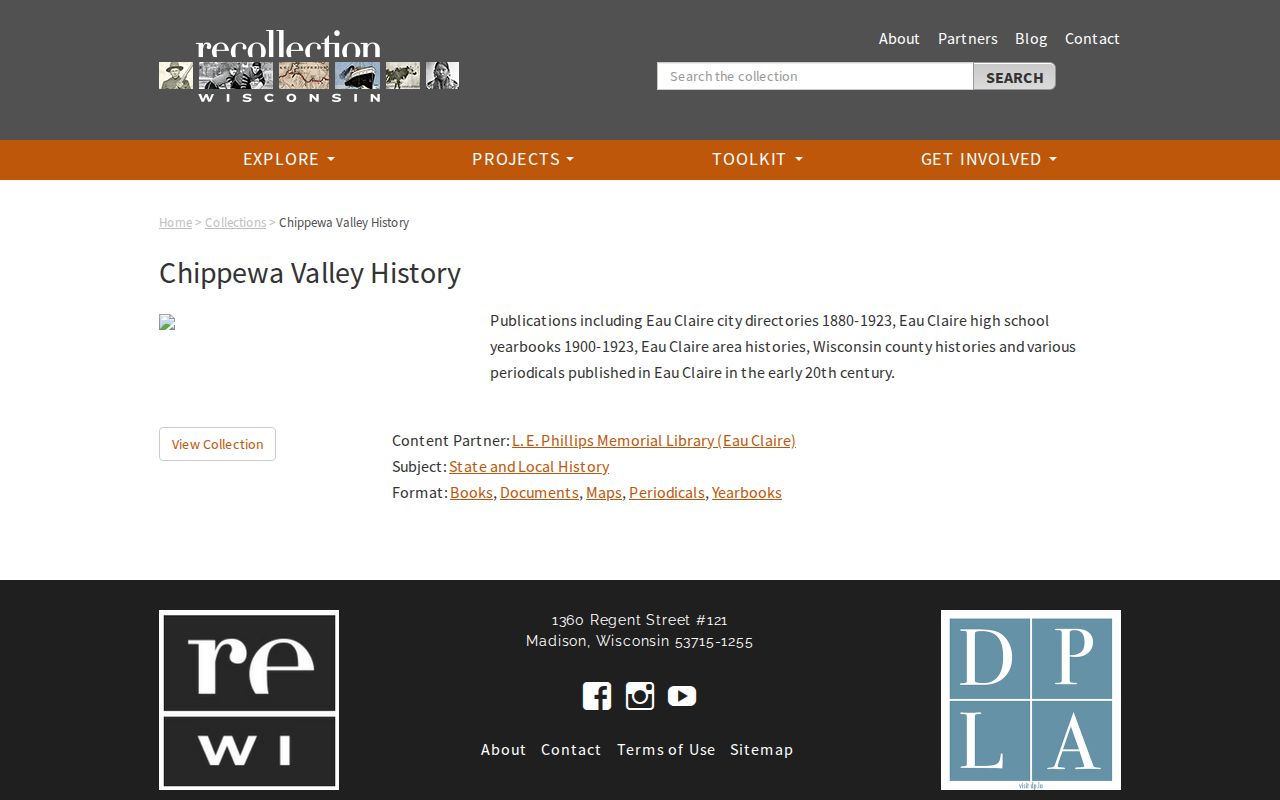
The 1880–1923 digital run is the clearest remote route. Chippewa Valley History combines Eau Claire city directories with high-school yearbooks from 1900 through 1923, local histories, county histories, and early periodicals. Search a directory image, then use those companion sources to test a school or community tie.
The Chippewa Valley History collection shown below leads into the local scans.
Save the volume title, year, image number, and printed page. That citation keeps the entry findable if links change.
Eau Claire Directory Reading Rooms
L.E. Phillips Memorial Public Library, at 400 Eau Claire Street, keeps genealogy tools in the Lois Barland Genealogy Room on Level 2. Its microfilm includes area newspapers back to the 1850s, census materials, and Sanborn maps. These sources can resolve an address when a name vanishes between editions.
UWEC Special Collections is at 103 Garfield Avenue. Call 715-836-2739 or email library.archives@uwec.edu. No appointment is required, though advance notice helps for a large request. Reproduction requests over 25 pages cost $5 plus $0.10 per page, subject to staff discretion.
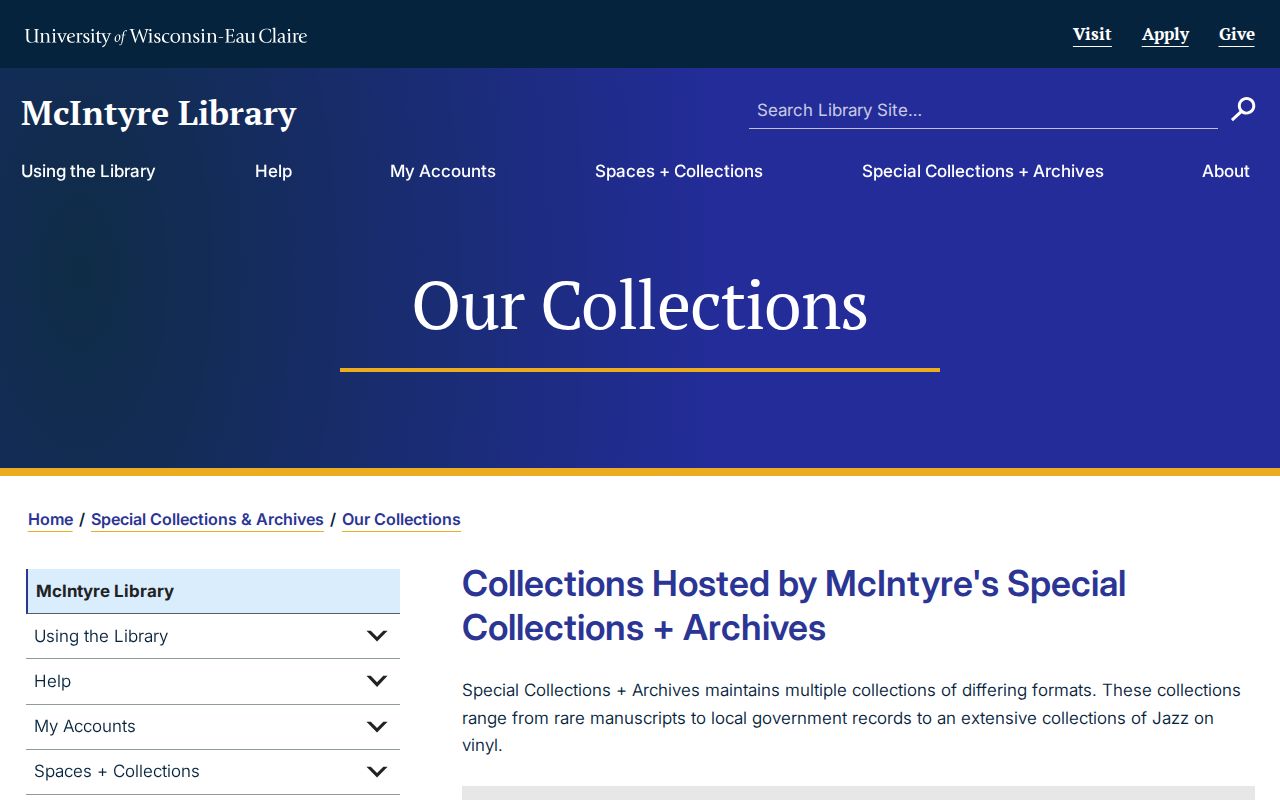
The UWEC archive page pictured below routes visitors to local history, maps, manuscripts, yearbooks, and city directories.
A catalog identifies where a source is held. Reading-room inspection confirms what the page says.
Read an Eau Claire Directory Entry
Transcribe each entry as printed. Capture surname, given name or initial, spouse notation, occupation, employer, and street address. A widow mark may connect a person to an obituary. An occupation may separate two people with the same name. Some books also have business or street-order sections.
No Eau Claire page was exposed as machine-readable text during research, so no sample quote or publisher-specific symbol is claimed. Use the key in the same volume.
| Name | Surname-first entry with given name or initial |
|---|---|
| Household | Spouse, co-resident, or widow wording where used |
| Work | Occupation and sometimes employer |
| Address | Street and house number when printed |
| Citation | Year, page, title, publisher, and symbol key |
- Criss-cross directory
- A reverse listing arranged by street or address instead of surname.
- Householder index
- A list centered on household names, linking a person and address.
- Abbreviation key
- The book’s guide to shortened words and marks. Save it before reading entries.
Early Eau Claire Directory Geography
Eau Claire grew from three river villages before becoming one city in 1872. Older sources may use East Eau Claire, West Eau Claire, North Eau Claire, or a county label. Bridges built in 1859 and 1869, plus the railroad’s 1870 arrival, shaped streets and business corridors.
When an early name is missing, test each village label and compare a map with the city directory. A modern neighborhood or ZIP should not be projected backward. Current names such as Historic Randall Park, East Side Hill, Shawtown, Third Ward, and West Riverside add context but do not replace the wording printed in the source.
Barland’s Eau Claire Name Index
Lois Barland’s notes add a rare local layer after a city directory identifies someone. The inspected Barland Biography Search displayed 11,172 records. Those notes supported Sawdust City, covering Eau Claire through 1910, and The River Flows On, covering 1910 through 1960. It is a finding aid, not a certified record.
Verify each narrative against a directory page, newspaper, deed, or vital record. This can help when a resident was linked to a mill, group, business, or neighborhood but appears only briefly in a listing.
Eau Claire Names Beyond Directories
The Eau Claire Historical Search obituary index includes names, maiden name, birth and death dates, source, and headstone fields. A row may cite the Eau Claire Leader-Telegram or Eau Claire Daily Telegram by date and page. Request that image through library microfilm or a licensed archive.
School yearbooks, the UWEC Periscope from 1917 through 1995, church histories, manuscripts, maps, and personal papers may add ties omitted from city directories. The index displayed 158,985 obituary and cemetery rows when inspected, though volunteer data may be incomplete.
Trace Families Through Eau Claire Directories
Build the family trail one edition at a time. Annual or near-annual city directories bridge long gaps between federal census schedules. A move, spouse’s surname, occupation change, or widow notation may distinguish people who share a name. Census records add household composition, while directories provide finer address continuity.
- Find the first known entry and save its year, page, spelling, address, and occupation.
- Move through nearby editions, noting each address, spouse label, job, and missing year.
- Check a street-order section when present. The exact Eau Claire reverse-directory run is not verified.
- Pair directory years with released censuses, especially 1880 through 1950.
- Close the trail with a newspaper, cemetery record, probate file, deed, or tax record.
A missing entry does not prove death or departure. The person may have been omitted, listed under another spelling, folded into a household, or outside the edition’s scope. Census schedules follow a 72-year release rule, so 1950 is public while 1960 is not generally due until 2032. For a current address, use the Eau Claire street directory workflow.
Later Eau Claire Directory Holdings
Repository lists extend the search after the local digital run ends. NARA’s circa-1930 list identifies Eau Claire volumes for 1929, 1931, and 1935. Allen County holdings name selected editions from 1905 through 1960, including 1926, 1929, 1931, 1935, 1937, 1939, 1941, 1943, 1946, 1949, 1951, 1954, 1956, 1957, 1959, and 1960. These are holdings statements, not evidence that every book is on an Eau Claire shelf.
Telephone-book lists provide another later bridge. Milwaukee Public Library identifies Eau Claire volumes for 1960, 1965, 1970, 1980, 1985, 1989–90, 1997–98, 2003, 2005, 2008–11, 2012–13, and 2013–14. Ask L.E. Phillips whether a local copy, microfilm, interlibrary option, or reference lookup is available. Give staff the year, surname, and likely street. A precise request saves time and avoids implying that a long list of catalog years is one continuous collection.
Later telephone volumes may organize names and addresses differently from the early city directory books. Record the title and section used, and never transfer a symbol or coverage assumption across series.
Eau Claire Directories Between Censuses
Federal census schedules offer household snapshots, while directories can show changes between them. Pair the directory run with 1880, 1900, 1910, and 1920 first. Later repository volumes can be compared with 1930, 1940, and 1950. Record every change instead of choosing the entry that looks most convenient. A person may shift from an initial to a full name, a spouse may appear or disappear, and an occupation may change while the street stays the same.
The directory does not prove each person in a household. It may emphasize a householder, wage earner, business, or phone subscriber according to the publisher’s practice. Census schedules help test age, relationship, birthplace, and household structure where those fields are open. Newspaper pages may then explain a move, death, marriage, or business transfer.
Recent census schedules remain closed under the 72-year rule. Do not fill that gap with a guess. Use directory and telephone listings as dated evidence, then test them against deeds, obituaries, cemetery records, probate, tax material, or other records available under their own access rules. Each source has a separate cutoff and privacy standard.
Confirm Eau Claire Directory Findings
A city directory entry is strongest when another source agrees. Start with the exact name and address, then look for the same pair in a nearby edition. Search surname variants, initials, maiden and married names, and likely spelling errors. Eau Claire’s French-Canadian, Scandinavian, German, Indigenous, and later immigrant histories make careful variant searching useful, but a surname never proves identity or heritage.
For a death trail, the GRSEC index can supply a newspaper title, date, page, and headstone clue. Request the original page through L.E. Phillips microfilm or a licensed database. The city’s Lakeview and Forest Hill cemetery staff also assist with historical location questions. A headstone or lot context may add relatives not named in the directory. For an estate, the Register in Probate can route open probate records; pre-1916 cases may be held through the Area Research Center.
For a property trail, copy the directory address and match it to a parcel, legal description, deed, or tax record. Street names and numbers can change, and the exact Eau Claire renumbering history was not verified. Sanborn maps, plats, council records, and newspaper notices can build the bridge without inventing a date. Keep a source log with edition, page, repository, link or call number, and the date consulted.
Eau Claire Archive Companions
UWEC’s Local History Collection extends well beyond city directories. It includes city, county, church, and organization histories; federal and state manuscript census microfilm; county atlases; Wisconsin Blue Books beginning in 1863; university yearbooks; maps; and local reference books. Special Collections also holds public records, organizational and business records, personal papers, and about 500 linear feet of manuscript material dating from the 1850s to the present.
Use the archive catalog and ArCat finding aids before a visit. A finding aid describes the arrangement and scope of a collection, but it does not index every person inside each folder. Send UWEC staff the name, date range, organization, street, and directory citation already known. Digital collections and onsite access to databases such as Newspapers.com and Access Newspaper Archive are routed through the archive, while offsite eligibility varies.
Yearbooks work especially well for students and school staff. Eau Claire high-school yearbooks from 1900 through 1923 appear with the Chippewa Valley History material, and UWEC’s Periscope covers 1917–1995. Published church or lodge histories may explain an affiliation first hinted at by an obituary. Naturalization and military sources can add another timeline, but no exact Eau Claire naturalization index was verified in the research.
Keep the evidentiary roles clear. A city directory can connect a printed name to an address and occupation. A yearbook may connect a person with a school. A manuscript can preserve correspondence or group records. None automatically proves that two similar names refer to the same person. Match dates, initials, relatives, addresses, and source context before merging identities.
Close Eau Claire Family Trails
A death notice often explains why a resident disappears from an Eau Claire city directory. Begin with the exact spelling and last known address. Search the GRSEC obituary and cemetery index with surname, first name, maiden name, and a likely date span. Copy the listed newspaper title, publication date, page, and headstone indicator. Then request the original page, because the index is only a pointer.
Cemetery evidence can confirm dates and family groupings. Lakeview and Forest Hill are city-owned cemeteries, and staff assist with historical location questions at 715-839-5041. The city’s 2026 budget reports about 39,316 grave sites and niches across the two cemeteries. That scale explains why a plot, section, or lot reference can be as important as a name.
Probate may continue the trail. Eau Claire County’s Register in Probate handles estates, wills, trusts, and related files. Library guidance states that probate records are open by law and points researchers toward local docket books for case numbers. Pre-1916 cases may be routed to the Area Research Center. A probate document can connect heirs and property, but access and retention rules remain distinct from directory coverage.